A Scripture-Grounded Examination

Are we living in the End Times?

Every generation has heard confident claims that the final hour has arrived. This site examines the Book of Revelation, its historical context, and the pattern of failed predictions to make a careful case: the evidence does not support the claim that we are currently living in the end times.

0 Chapters examined
0 Core arguments
0 Years of predictions
Scroll

The Case

Confidence is not evidence.

Claims that "we are living in the end times" often feel compelling because they connect ancient symbols to modern headlines. But compelling feelings are not the same as sound interpretation. Below are seven evidence-based reasons to be skeptical of present-day end-times certainty.

Seven Arguments

Why the "right now" claim falls short

01

Scripture explicitly denies date certainty

Jesus states plainly that no one knows the day or hour (Matt 24:36; Mark 13:32). Revelation blesses those who keep its words (Rev 1:3), not those who construct confident calendars. Any system that claims to identify the present moment as definitively "the end" contradicts this clear limit.

Biblical constraint

02

Revelation was written to real first-century churches

The book is addressed to seven churches in Asia (Rev 1:4, 11; ch. 2–3) and speaks of things that "must shortly come to pass" (Rev 1:1) for "the time is at hand" (Rev 1:3). This original audience and time-frame language must be reckoned with before mapping every symbol onto modern events.

Historical context
03

"Signs" have been present in every century

Wars, rumors of wars, famines, earthquakes, plagues, persecution, and false teachers (Matt 24; Rev 6) are tragically recurring features of human history. Selecting today's examples while ignoring identical or worse conditions in past centuries is confirmation bias, not prophecy fulfilled.

Pattern recognition
04

Failed predictions form a 2,000-year pattern

From early millennial movements to 1844, 1914, 1988, 2000, 2012, and countless modern date-setters, confident end-times predictions have repeatedly failed. A claim with a consistent record of failure should carry a heavy burden of proof, not automatic trust.

Track record
05

Symbolic language is being read as newspaper headlines

Revelation is apocalyptic literature, rich with symbols: beasts, horns, lamps, stars, a dragon, a woman clothed with the sun (Rev 12–13, 17). Treating symbolic imagery as a one-to-one code for modern technology or politics ignores the genre and invites endlessly shifting interpretations.

Genre & method
06

The global "all nations" conditions are not uniquely now

Many end-times claims rely on global reach, universal worship, or worldwide control (Rev 13:7–8, 16–17). Yet the Roman world already understood "all the world" in imperial terms (cf. Luke 2:1). Modern globalization makes claims feel plausible, but plausibility is not fulfillment.

Interpretive caution
07

Revelation's own arc ends in hope, not headline panic

The book moves through judgment to renewal: a new heaven, new earth, and New Jerusalem where tears, death, sorrow, and pain pass away (Rev 21:1–4). Its purpose is to call for faithful endurance and worship, not to fuel fear-driven speculation about current events.

Purpose of the text

The Text vs. The Claim

What Revelation actually describes

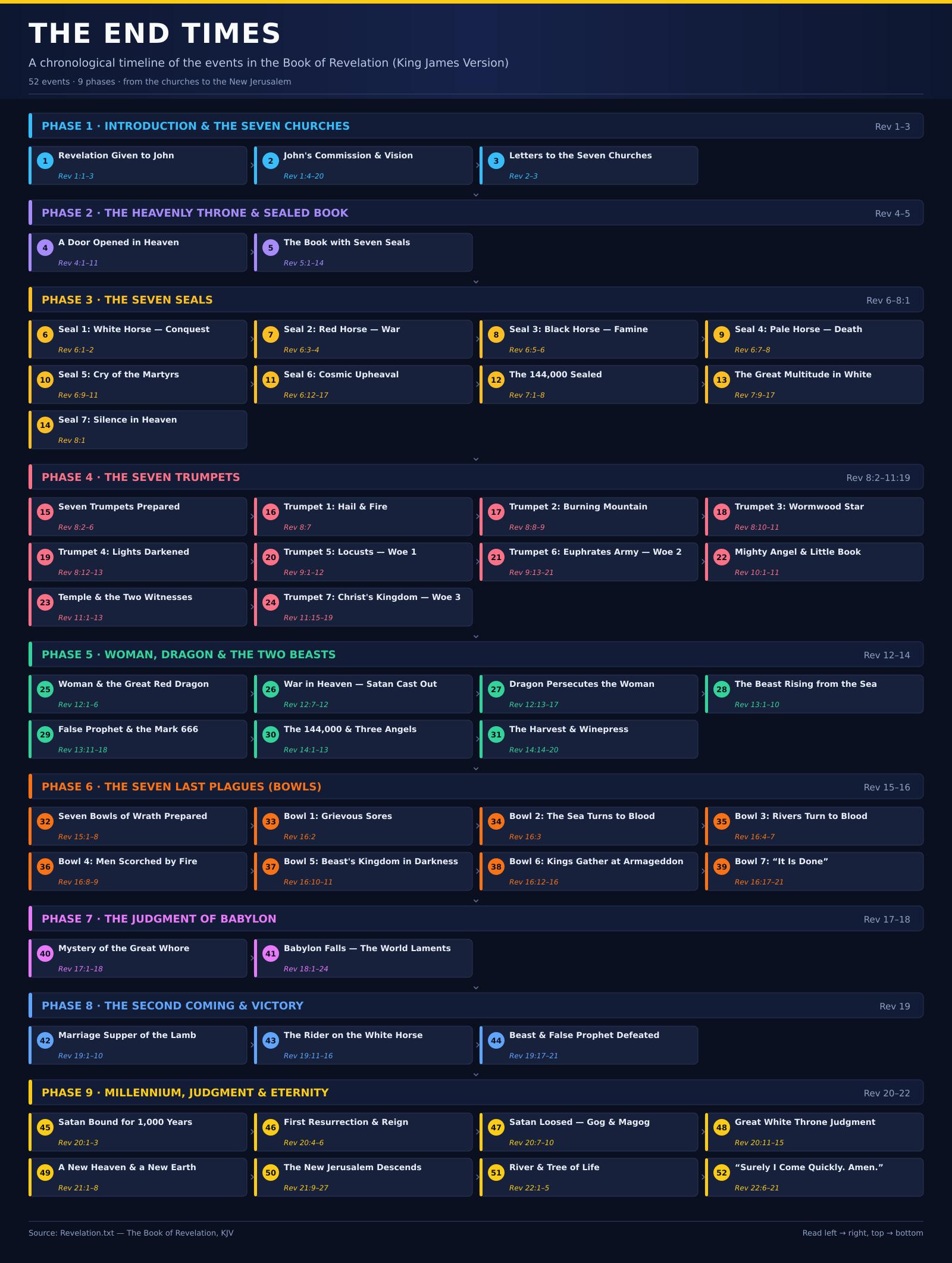
The popular "end times timeline" often presents a confident sequence mapped to modern headlines. But Revelation is a complex apocalyptic vision given to first-century churches. Seeing the full arc in context helps reveal how much interpretation is being added.

Revelation end times timeline infographic showing seals, trumpets, bowls, and final judgment
The popular timeline summary (click to enlarge). Compare its certainty with the text's own symbolic, layered structure.
Rev 1–3

Seven real churches

Specific messages to Ephesus, Smyrna, Pergamos, Thyatira, Sardis, Philadelphia, and Laodicea. These were real communities with real problems — not coded labels for modern nations.

Rev 4–5

Heavenly throne room

John is taken up in vision to see God's throne and the Lamb worthy to open the sealed scroll. The scene establishes divine sovereignty before any judgment unfolds.

Rev 6–16

Seals, trumpets, and bowls

Three cycles of seven judgments with vivid symbolic imagery. Scholars debate whether these are sequential, recapitulated, or symbolic — the text itself resists a simple modern-newspaper mapping.

Rev 17–18

Babylon judged

"Babylon the Great" is depicted as a harlot riding a beast. First-century readers would have recognized Rome; later readers have identified other powers. The symbol's flexibility cautions against dogmatic modern identification.

Rev 19–20

Christ's victory and final judgment

The rider on the white horse, the defeat of the beast, the millennium, Satan's final rebellion, and the Great White Throne judgment. These are cosmic, decisive events — not ambiguous trends.

Rev 21–22

New creation

The book ends not with coded fear but with renewal: "Behold, I make all things new." No more death, sorrow, crying, or pain. The final word is grace and invitation — "whosoever will, let him take the water of life freely."

Scripture in Context

What the text actually says

These passages from Revelation and related texts are often cited in end-times claims. Read in context, they encourage humility, faithfulness, and caution — not date-setting confidence.

"The Revelation of Jesus Christ, which God gave unto him, to shew unto his servants things which must shortly come to pass..."
Revelation 1:1 Time-frame language addressed to the original audience.
"Blessed is he that readeth, and they that hear the words of this prophecy, and keep those things which are written therein: for the time is at hand."
Revelation 1:3 The blessing is for reading, hearing, and keeping — not predicting.
"But of that day and hour knoweth no man, no, not the angels of heaven, but my Father only."
Matthew 24:36 A direct boundary against certainty about timing.
"And he said unto them, It is not for you to know the times or the seasons, which the Father hath put in his own power."
Acts 1:7 The disciples asked for timing; Jesus redirected them to mission.
"...for ye know neither the day nor the hour wherein the Son of man cometh."
Matthew 25:13 The parable's point is readiness and faithfulness, not calculation.
"For I testify unto every man... If any man shall add unto these things, God shall add unto him the plagues... And if any man shall take away..."
Revelation 22:18–19 A sober warning against distorting the prophecy's words.

A better posture

Faithfulness over fear.

Revelation calls its readers to endurance, discernment, and worship. The responsible response to uncertain times is not panic or prediction — it is faithful living, clear thinking, and humble reading of the text.

Common Questions

Honest answers to common claims

But aren't wars, earthquakes, and pandemics increasing?

Such events have occurred in every era. Modern 24/7 news and global communication make them more visible, not necessarily unprecedented. Jesus himself warned that "wars and rumours of wars" and earthquakes are "the beginning of sorrows," not the immediate end (Matt 24:6–8). Using recurring tragedies as a countdown clock has failed repeatedly throughout history.

What about Israel, technology, or the mark of the beast?

Revelation 13 describes a mark tied to worship of the beast and economic participation in a highly symbolic vision. Identifying it with specific modern technologies (barcodes, chips, digital IDs) requires importing assumptions into the text. Similar identifications have been made for centuries — Roman coins, social security numbers, credit cards — and all have been wrong. The text calls for wisdom and discernment (Rev 13:18), not speculative certainty.

Doesn't "shortly come to pass" mean it could still be future?

It could be interpreted various ways, and scholars hold different views (preterist, futurist, historicist, idealist). The point here is not to force one complete system, but to show that the confident popular claim — "we are definitely in the end times right now" — ignores legitimate interpretive complexity and the text's own warnings against knowing times and seasons.

Is this site saying Revelation is untrue or irrelevant?

No. This site treats Revelation as a serious, meaningful text worth reading carefully. The argument is against confident present-day end-times claims, not against Scripture. Revelation's themes — God's sovereignty, the danger of evil, the call to faithfulness, and the hope of renewal — remain powerful regardless of one's timeline view.

Why does this matter?

Date-setting and end-times panic can cause real harm: fear, manipulation, financial exploitation, neglected responsibilities, and cynicism when predictions fail. A careful reading protects people from sensationalism and honors the text's actual call — faithful endurance, discernment, and hope.

The Takeaway

Read carefully. Hold claims loosely. Live faithfully.

The Book of Revelation is profound, challenging, and worthy of deep study. But its complexity should make us humble, not certain. When someone claims we are definitely living in the end times, the most biblical response may be the simplest: we do not know the day or the hour.

Open sky representing hope and peace

"He which testifieth these things saith, Surely I come quickly. Amen. Even so, come, Lord Jesus."

Revelation 22:20